
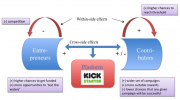
A number of posts on this blog have already dealt with multisided platforms (see here) and with crowdfunding (see here). My aim with this post is to link the two topics and show that crowdfunding platforms are a prime example of multisided platforms. Crowdfunding platforms (CFPs) facilitate the interaction between entrepreneurs trying to raise funds […]
Author Archive | Paul Belleflamme

Crowdfunding: giving rewards or sharing profits?
By 20 May 2014 0
As already explained on this blog, crowdfunding has recently emerged as a novel way of financing new ventures. The basic idea behind crowdfunding is simple: instead of raising funds from a small group of sophisticated investors, entrepreneurs try to obtain them through the Internet from a large audience (the so-called “crowd”), where each individual provides a […]

A ‘multisourced’ case-study of a multisided platform
By 4 April 2014 27
To paraphrase a famous Belgian surrealist artist: “This post is not a post“. More precisely, it is not a post yet, but it should become one once all your comments will be pieced together. My goal, in a very lazy educational way, is to build a case study of a specific multisided platform through crowdsourcing (which […]

When sheiks and cheques shake the media
By 26 March 2014 18
A media bias is defined by Wikipedia as the bias or perceived bias of journalists and news producers within the mass media in the selection of events and stories that are reported and how they are covered. The first source of media bias that comes to mind is political. It is indeed often perceived […]

What drives self-regulation in the nascent P2P “ride-sharing” industry?
By 18 March 2014 33
The American company Uber has been all over the news in Belgium over the last three weeks. Uber connects passengers with drivers of vehicles for ride-sharing services; it appears therefore as a typical two-sided platform. As Evans (2011) explains it, a business opportunity emerges for a two-sided (or multi-sided) platform when three conditions are met: There are distinct […]

How do comparison shopping sites make a living?
By 6 March 2014 23
Comparison shopping sites, also known as shopping robots or shopbots, have been around for about two decades. Sites such as Shopping.com, Shopper.com, PriceGrabber, Shopzilla, Vergelijk or Kelkoo help us find goods or services that are sold online by providing us with loads of information (products sold, price charged, quality, delivery and payment methods, etc.). As they […]

Prezi: a successful freemium model?
By 24 February 2014 25
Last year, I had to deliver a speech about the economics of Internet to a non-technical audience. To make my presentation (hopefully) more pleasant for this audience, and to seize the opportunity to learn a new application, I decided to use Prezi. The application was rather new at the time (it had been launched in 2009 […]

Can IPdigIT start a snowball effect?
By 12 February 2014 12
In a previous post, I described the success story of Alex Tew who managed to raise $1 million for his university education by selling one million pixels on a web page, at at price of $1 per pixel. In exchange for the pixels that they bought, purchasers had the possibility to display tiny images on them, […]

Will the new Belgian Telecom Act lead to lower prices?
By 31 January 2014 9
Since October 1st 2013, a new ” Telecom ” Act transposes into Belgian law a series of European directives to better protect consumers in the telecommunications market. A key measure of this law is the opportunity that is now given to consumers to switch operators (fixed and mobile telephony, Internet and television) without any penalty after […]

The hidden treasure of piracy?
By 2 December 2013 41
You probably know “Game of Thrones”, the most popular TV series of the moment. The first two seasons were a huge hit and the third season premiered on March 31, 2013 on HBO (the American premium cable network that produces the series). There are about 4.5 million subscribers who follow the series. But overall, the […]
1 2 … 6 Next →