

Most innovations are the result of a cumulative R&D process, i.e., their production requires the combination of knowledge contained in previous innovations (for a general presentation, see my previous ‘Dig It!’ post). Cumulative innovations raise specific problems that put the patent system under stress. We already explained on this blog that holdup strategies or licensing […]
Content types Archives: Article

Patent races: pros and cons
By 5 November 2014 25
We have already developed on this blog the relationship between competition and innovation (see here and here). This relationship goes both ways. On the one hand, competition affects innovation insofar as the firms’ incentives to innovate depend (in a complex way) on the market structure (i.e., the number of firms on the market, the way they compete, the type […]

To induce innovation, should we praise the prizes?
By 3 November 2014 40
Innovation is a tricky economic activity: its input (R&D) is very costly, its production process is highly uncertain and its output (the resulting knowledge) has the features of a public good. Absent proper institutions and policies, private incentives for research and innovation may thus be insufficient with respect to what our societies need to sustain […]

A primer on cumulative innovations
By 21 October 2014 0
(This post aims at digging the concept of cumulative innovation. It is based on Section 19.3 of Belleflamme and Peitz, 2010). Innovations are rarely produced in complete isolation. In many complex industries (such as biotechnologies, information technologies, telecommunications, electronics and software), innovations are typically the result of a cumulative process. For the sake of the […]

When solving copyright cases requires to balance fundamental rights
By 30 September 2014 44
Copyright cases until recently were mainly decided with reference to the rules contained in the statutes (the relevant Copyright Acts) and on the basis of the principles deriving from case law. Under the influence of the Court of Justice of the EU (CJEU) and of the European Court on Human Rights (ECtHR), a growing number […]

3 master theses about crowdfunding
By 11 September 2014 0
Every academic year at the Louvain School of Management, about 500 master theses are defended. Research topics span all disciplines of management science. In their research, students either address a practical issue raised by a particular organization or aim at contributing to the theoretical or empirical literature in management. This year, four theses had to […]
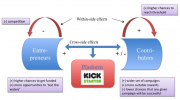
The multisidedness of crowdfunding platforms
By 17 June 2014 0
A number of posts on this blog have already dealt with multisided platforms (see here) and with crowdfunding (see here). My aim with this post is to link the two topics and show that crowdfunding platforms are a prime example of multisided platforms. Crowdfunding platforms (CFPs) facilitate the interaction between entrepreneurs trying to raise funds […]

Putting a price on privacy – but how?
By 8 June 2014 0
This is the third part of a series that discusses the value of personal information in the digital economy. You can find the first and the second part here and here. This series of posts is motivated by the pricing model the telecommunications provider AT&T employs for its GigaPower broadband service. Just to recall, AT&T […]
Putting a price on privacy – an Introduction to the Economics of Privacy
By 1 June 2014 0
This is the second part of a three-piece series that discusses the value of personal information in the digital economy. You can find the first part here. I started my previous post by asking how much you would be willing to pay in order to prevent your Internet provider from tracking and analysing your browsing […]
Putting a price on privacy – are there benefits to sharing private information?
By 25 May 2014 0
How much would you be willing to pay in order to prevent your Internet provider from tracking and analysing your browsing history? According to AT&T, the Texas-based telecommunications provider, between $29 and $62 a month. Back in December 2013, the company launched its new GigaPower service, which from summer 2014 onward is supposed to deliver […]
1 2 … 10 Next →